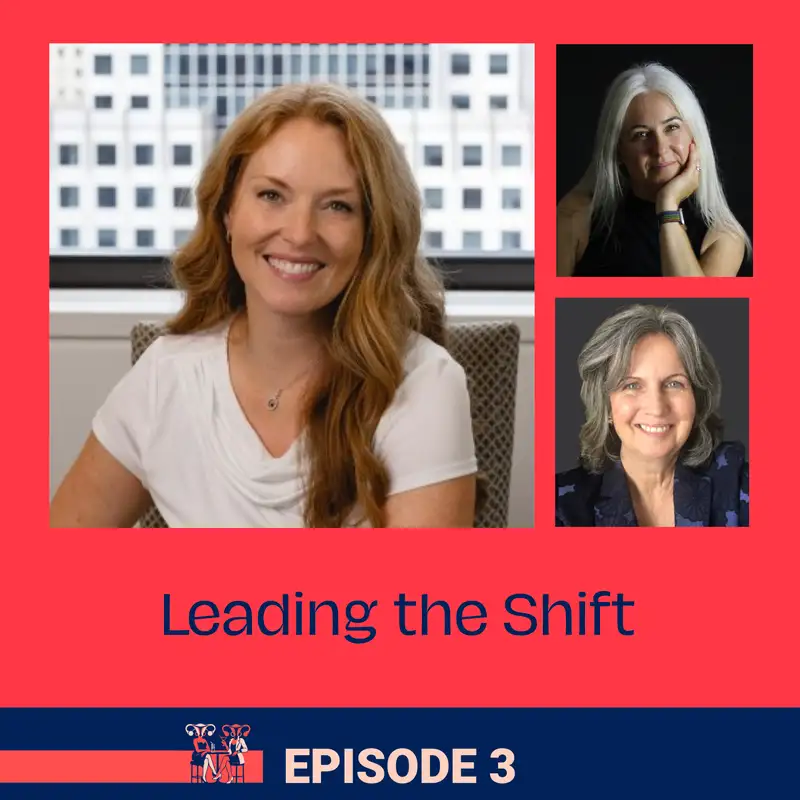
 Episode 3
· 32:34
Karen (02:50)
Our guest today is someone who's not just designing better products. She's helping redesign the health experience for women in midlife and beyond.
Gabrielle (02:57)
Tracy McNeil is the CEO of Materna Medical, a company using science and empathy to tackle overlooked women's health conditions like pelvic floor disorders with real solutions that are clinically smart and emotionally intuitive.
Karen (03:11)
She's also an engineer, a mom, and a champion of women-centered innovation. And she brings a powerful perspective on how we can build brands that meet women where they actually are.
Gabrielle (03:24)
Tracy, welcome to Two Uteruses Walk into a Bar.
Tracy MacNeal (03:27)
Thank you so much. It is such a pleasure to be here.
Gabrielle (03:33)
It's a lot of hats. I think that's important to call
I don't want to spend too much time, but I think it's very interesting to ground us in your experience and how you landed at Materna.
Tracy MacNeal (03:45)
The way I think about myself is a technical leader. I specialize in the commercialization of medical devices. So making things that can be complicated, trying to make them simple, is what I do. an undergraduate. I'm a chemical engineer. I started in pharma.
But even in my first job out of school, I started in a manufacturing management development program. So it was very much geared towards grooming leadership and communication skills amongst technical people.
And so my crackpot theory is that engineers who can communicate get put in communication roles pretty quickly. And so that's more or less the story of my career is working on technical teams that were launching different kinds of innovation in healthcare. And in about maybe 10 years into my career, I got my MBA. And that was a real turning point for me where I made a conscious decision.
Gabrielle (04:13)
Mmm.
Yeah. ⁓
Tracy MacNeal (04:36)
to be more around commercialization, fundraising, M &A. And so worked startup that had a successful with one of the big strategics and worked for mid-sized companies for a couple of years and that's where I was Materna called. So I'm not the founder of Materna. They were running a search for essentially the commercial CEO and I had never heard of anything that
Gabrielle (04:54)
Mm-hmm.
Hmm.
Tracy MacNeal (05:04)
every time I had a conversation with another person at the company I got more interested. I had never worked in women's health and I never had the opportunity kind of run my own show that way. And as I learned how large the market was, how deeply these needs were unmet and the lack of...
Gabrielle (05:14)
Mm-hmm.
Tracy MacNeal (05:22)
competition, I thought, the challenge there is going to be being a first mover and telling a story about something that is maybe uncomfortable for some people or taboo or ⁓ embarrassing. And I had to get over that myself because I was a respectable person working in orthopedics and whatnot. To then begin getting up every day on behalf of women's pelvic health was a ⁓ conscious decision I had to make.
Karen (05:34)
Yeah.
Gabrielle (05:38)
Yeah. Yeah. Yeah.
Tracy MacNeal (05:50)
I was going to go first. I was not going to be embarrassed about this and I was going to try to normalize it and hopefully bring other
Gabrielle (05:56)
I love that.
Karen (05:56)
Was
it the concept of pelvic health that was the issue or was it like the language surrounding pelvic health that was the issue? Yeah, okay.
Tracy MacNeal (06:06)
I mean, actually six years later, things are so much better. Really
things have changed a lot. But in 2019, when I was accepting the interview, I mean, nobody was talking about pelvic health, not really. There were a couple of early players, you know, like LV, the LEVA system, the Ixenonome, right? They were early.
Gabrielle (06:25)
Yeah.
Tracy MacNeal (06:28)
to that party, for the most part, really, mostly people were not comfortable talking about pelvic health and the pelvic floor PT investments had not yet been made. know, midi health wasn't a thing yet. And so it was that. And then it was also honestly the devices that we have at Materna. They look like sex toys to a lot of people, right? I mean, if you've ever seen anything that goes into a vagina, you might associate it with that, right? And so.
Gabrielle (06:48)
Yeah.
Tracy MacNeal (06:53)
is the first time in my career where I really don't lead with the devices because they're very distracting for people. know, it's just, I mean, even people who are comfortable, it's still like, okay.
Karen (06:58)
Okay.
Yeah,
it's so interesting how those things get conflated, you know,
Gabrielle (07:07)
And also here you are coming from an engineer background, being a communicator new
And here you are faced with a portfolio and the challenge of figuring out how do we get this company profitable and what do we do? So what were some of the first things that you did to, like in the first hundred days?
Tracy MacNeal (07:33)
maybe I'll talk a little bit about our products, folks that don't know us. So we have one product on the market, it's called Milli It's an expanding vaginal dilator. floor health as a space, most of the conversation is around pelvic floor laxity.
and we're not working in that space. ⁓
We have our first product on the market is Milli treating a high tone pelvic floor disorder. It's sort of the opposite issue where the pelvic floor is too tight. And usually what's going on there is that sex has hurt for a long time. Some kind of chronic thing, whether it can be chronic yeast infections, can be fibroids or endometriosis, can be menopause is actually the largest group where the tissue is drier or thinner and just like
Karen (08:17)
Okay.
Tracy MacNeal (08:21)
you know, just hurts. And then on top of it, she starts to, her body starts to brace itself, like in anticipation of the pain. And sex becomes painful or impossible. And it has a name now. It is called vaginismus, rhymes with Christmas, and that's how you can remember it. ⁓ So what I, so, and then our second product is just finishing up a big pivotal trial.
Karen (08:35)
Okay. ⁓
Gabrielle (08:37)
You
Tracy MacNeal (08:47)
⁓ aiming to prevent those pelvic floor injuries that happen during childbirth. So a lot of that pelvic organ prolapse and the associated incontinence with that, those were five times more likely to have that problem if we've had a vaginal delivery.
Karen (09:03)
an exciting duo of products able catch an issue, early in a woman's life while she's during her childbearing years But also have some sort of therapy to offer for
the other end of the timeline on that, know. Yeah, yeah, that's exciting. Yeah.
Tracy MacNeal (09:16)
Yeah, yeah, right. Yeah, so our second product is called Ellora, and it's
a single-use disposable would be used during labor and delivery. And so the idea, to your point, would be that we could maybe make pelvic organ prolapse, maybe a thing that's much less So that's what we were doing. Now, what happened when I joined the company was that Milli had been launched.
Karen (09:24)
Okay.
Tracy MacNeal (09:40)
as what's called a wellness product. So didn't have a FDA clearance, which is fine. You can do that. But the importance of FDA clearance is really to protect the consumer. Like what are you saying about the product? So when you get FDA clearance, I don't know if people know this, when get FDA clearance, it's actually not for the product, it's about the marketing.
So Milli was out there and it really from a strategy standpoint and really ultimately serving the patients need better care. We're trying to get these channels so the patients have easy access. Having Milli without FDA clearance.
out as a D to C product and then Ellora is going to be a hospital sale used in labor and delivery like this was going to be too many things for a little company to try to do. And ultimately I felt like it was clear that patients deserved to have plainer speech about Milli. What is vaginismus? How do I know if I have it?
Gabrielle (10:22)
Yeah.
Tracy MacNeal (10:34)
how treatable is it, all of those things. We needed to be able to talk about it and we needed FDA clearance for that. So that was really one of my earliest decisions.
Gabrielle (10:44)
And that's when we were originally talking and you mentioned you sort of were working a little bit backwards because you had to make this case for the indication. ⁓ And so you mentioned you brought together some KOLs, thought leaders in pelvic floor health.
looking on on Reddit for instance and just typed in you know painful intercourse to see because you were talking about you know what do we even call it there is first of all there is a vaginismus community 42,000 people but I'm yeah 42,000 people
Tracy MacNeal (11:16)
42,000 people in the back of this building
Gabrielle (11:19)
And I find it so interesting that, you know, you were talking about just the sort of the embarrassment around the topic, giving people language about the topic and having those conversations with their clinicians who can actually help, but for very long people and continue to go online.
And I think that, you know, giving people the right language, giving people some sort of understanding of what's really happening and then guidance on how they can solve it. How have you seen the role of online as far as getting your messages out there, educating the women? You know, when you talked about that very first step, where how did you start doing that? What channels were you using?
Tracy MacNeal (12:00)
So that's been a very interesting evolution over the last six I think most people would agree that the D to C selling direct to consumer has become a very unscalable business model. In the beginning, we were really making most of our connections with patients through Google. So they're Googling painful sex, and we're bidding on those keywords.
landing pages that ideally would give them information about what was going on for them and whether they have vaginismus, because painful sex and vaginismus are two different things. Vaginismus is really the pelvic floor contraction. And painful intercourse, of course, can happen for, you just, you can have a yeast infection for a week and that's different, right?
Gabrielle (12:41)
Thanks.
Tracy MacNeal (12:42)
So that was pretty successful in the beginning, but over the years, the combination of everyone trying to get out there and bidding on the same keywords, sort of inflationary on the costs of that, but then also the changes to privacy, which as citizens we probably support, but it has quintupled the costs associated with trying to reach those patients. And then on top of it,
Gabrielle (13:01)
Mm-hmm.
Karen (13:05)
Sure. Yeah. Yeah.
Tracy MacNeal (13:09)
We have censorship, ⁓ not even by humans. These are bots that automatically censor things that we're talking about. And not just because we're in pelvic health, but also just medical products have become increasingly difficult to talk about through the Facebook, Instagram, Google channels. And so I try to be fair and balanced about that. I mean, I think a lot of it is to try to protect people.
Gabrielle (13:13)
Thank
Tracy MacNeal (13:33)
try to protect patients from greedy entrepreneurs. And it can be very difficult to get clear communication out to people for something that makes sense financially.
Karen (13:43)
Yeah,
we've been talking a lot about language. How important do you find the ability or the issues with I mean, right now we were talking about the fact that in fact, you know, things that are automated are going to be filtering you out.
I imagine based on the language that you're using when you're trying to do direct to consumer marketing, right? So can you speak to that experience as you were trying to get your vision for the company up and running and any issues that you had with language and how you used that?
Tracy MacNeal (14:14)
I could try to tie a few things together here. We made the decision to double down in the healthcare practitioner space. So we'll call them HCPS, healthcare practitioners. For us that could include OBGYNs, could include nurse practitioners, it could include physical therapists, clinical psychologists. There are a lot of types of people that see folks that have sexual function questions. And ⁓ so we decided that
it was going to be in better service to everybody, notably the patient, but really the clinicians that are trying to serve them as well, to try to bring everyone together and get some alignment. And the first thing that we did was try it. So we got FDA clearance and that was great. Then everybody needed a prescription. And a lot of those folks don't write prescriptions. Physical therapists typically would not be able to write a prescription. So then that puts up ironically a barrier to patients getting what they're looking for.
Gabrielle (14:59)
drink. ⁓
Tracy MacNeal (15:10)
And so what we did was we brought, we started trying to run a clinical study to get some evidence also because patients would naturally want to know whether the product works or not. And in order to say if product works, you need the clinical evidence about that. And we realized that there really wasn't even enough alignment amongst the key opinion leaders in this space about what the condition would even be called and how you would even diagnose it.
So we made the decision to bring them together, write the white paper. Our company was the one that sponsored the white paper. And we brought several of the top minds in the space with a lot of great clinical practitioner experience. And they have different perspectives, but we were able to get enough of an agreement that then we were able to get the indication and alignment that yes, this is the problem we are solving. It's called vaginismus. And give people a name so that they're not chasing some random
experience what we were seeing in our market research was that most people who have this situation do not know what it is, do not know that it is incredibly common, and they do not know that it is very treatable. And then they, because it has not really been invested in, so this is like sort of the chicken egg thing, because it hasn't been invested in, there hasn't been enough research, it's not taught in medical school, so patients go to the doc, if they're the really...
Karen (16:29)
Yeah, yes.
Tracy MacNeal (16:33)
warrior types that go to the doctor and try to take care of themselves, the doctor may not actually know. And so we were really trying to be of service in that whole ecosystem. And so then the second thing that we did was we ran the first, what's called a self-selection study. What we really felt was that when we looked at the way that these patients were being treated, they were being passed around in our surveys.
Karen (16:43)
Yeah, okay.
Tracy MacNeal (17:00)
we saw in hundreds of patients, saw that on average they were seeing five or more clinicians who could not help them. Suffering for years. Yep. And they were being told things like, it's all in your head. You're fine. You're just small. Have a glass of wine. Try to relax. Right. And really, you know, kind of gaslighting and what we wanted to do was put more empowerment in the hands of the patient herself.
Gabrielle (17:07)
⁓ That's shocking.
Yeah. ⁓
Yeah, you're too uptight.
Karen (17:17)
Yeah. Yeah. Yeah.
Tracy MacNeal (17:28)
And so we ran the self-selection study to show, clinically, that if you give patients the right information, they know what they have. They can decide correctly, positively or negatively, if they have this condition.
Karen (17:42)
Now,
could you talk a little bit more about that? I find that really interesting because is absolutely talking right to today's topic.
Gabrielle (17:45)
Mm-hmm.
Karen (17:50)
And tied into this is an issue with really the remnants of an old way of using language in the medical space. The fact that we still call hysterectomies, hysterectomies and not uterectomies across the board, ⁓ you know, things like that.
Gabrielle (18:03)
Great.
Karen (18:07)
I'm in my early 60s and there's absolutely a dearth of language for me growing up. mean, there was no way to be able to frame and talk about these things. You found a way to evidence to show what you just said, which is give them the tools and they can actually just...
decide things for themselves. So I just want you to expand on that a little bit because I is addressing the issue that women have always had with the marketing and the medical advice and care that they've been getting and how a brand can be addressing that the way you guys have.
Tracy MacNeal (18:38)
Yeah.
Gabrielle (18:41)
Yeah.
Tracy MacNeal (18:42)
I so
appreciate what you just said. tying it back to where we started talking about leadership, for me it ended up being a relentless...
Karen (18:47)
Mm-hmm.
Tracy MacNeal (18:52)
unwavering asking of why can't we, like I had to bring together the team who could figure out what to do, right? I had never worked on a device that was so terribly underdefined. I had never been asked to work on a clinical device where people did not even understand what the problem was we were trying to solve. So.
Karen (18:54)
Okay.
Gabrielle (19:11)
It's fascinating, yeah.
Tracy MacNeal (19:13)
That
Karen (19:13)
Yeah,
Tracy MacNeal (19:14)
was
Karen (19:14)
it really is.
Tracy MacNeal (19:14)
really wild. I mean, I have the most amazing team ever. And it took us a while, and we have amazing investors who supported us, because the stuff isn't free either. People have no idea how much these kinds of things cost. It's like a million dollars to get FDA clearance. I mean, at least, right? So these are not.
Karen (19:32)
Yeah, yeah.
Tracy MacNeal (19:34)
throw away things and you have to convince investors that these patients really do deserve better care and that they will purchase this device if you help them get what they need and give them the support that they're looking for. The way it worked in the end was we educational web page which is part of our labeling so we can't just change our website because we feel like it. This is part of our clinical labeling.
Karen (19:40)
Yeah, okay.
Gabrielle (19:58)
Right.
Karen (20:00)
Right.
Tracy MacNeal (20:01)
but it gives patients a fair amount of information about what vaginismus is and isn't. And then they went into a doctor and they filled out the form and they just they checked whether they thought they had vaginismus and whether they thought Milli would be right for them based on what they read. And then they independently saw a doctor who made the same decision for them. And we wanted to see, you know,
whether they lined up and they did. Yeah, women know. They don't need a doctor to tell them whether they have vaginismus or not if they have the right information. Right?
Karen (20:27)
That's great, yeah. Yeah, yeah, yeah. Right, yes.
Gabrielle (20:35)
how did that marketing, that outreach to the HCPs, what were some of the things that you did, the strategies to get this message out? And really it sounds like Materna was at the forefront of this conversation. You had the technology and now you were the...
the plight of the pioneer, which is you have kind of do the hard fight and pave the road for other people. So what were some of the things you did strategically to get that out there?
Tracy MacNeal (21:00)
Yeah.
Karen (21:04)
Yeah, good.
Tracy MacNeal (21:07)
that well we are aiming to be the brand that's defining the category so in the same way that Viagra does for ED all these years later right everybody knows what you're talking about but in the beginning nobody would have expected baseball players to be talking about a erectile dysfunction on TV right but here we are 30 years later we're hoping it doesn't take 30 years but we're six years in you know I mean these things do take time. so good news
Karen (21:24)
Right. Yeah.
Yeah.
Gabrielle (21:31)
Yeah.
Tracy MacNeal (21:36)
Milli is a covered benefit for veterans and veterans have a higher than average incidence of vaginismus around trauma and sexual trauma is one of the primary conditions that can lead to vaginismus and plus veterans are people and have all the same things that other people have. So I'm glad that it's a covered benefit for them and that's really where we've chosen to build out our clinician facing
channel mostly because health equity is important to us. are trying to, we would love for Milli to be a cover benefit for everybody. Probably a longer story. It's probably a whole nother podcast episode on reimbursement and women's women's health cause I still get asked if women's sexual health is a nice to have or a need to have. Yeah. Yeah. Is this, is the fact that sex is painful or impossible for her like,
Gabrielle (22:10)
Yeah, reimbursement, exactly.
Wow.
Karen (22:20)
Right.
Yeah.
Tracy MacNeal (22:26)
nice to have or I need to have.
Karen (22:27)
yeah,
Gabrielle (22:28)
Holy cow,
Tracy MacNeal (22:29)
Yeah, that's the primary barrier to broader coverage for don't think it's impossible. I think it can be done. But as an entrepreneur, I have to think about what investors will pay for and where clinicians will show up helping their patients. What we found is that over the years, as we've shown up with more and more clinical evidence and
validation really of the whole space, naming what is happening and how we talk about it, really leading that from a technical perspective, not as a mom and pop, know, hey, I've got this idea, but like, we are a medical device company and we are in service to these patients. We found that more and more of our clinicians are willing to ask themselves, am I asking my patients if they're having sex?
Gabrielle (23:13)
Thank you.
Tracy MacNeal (23:13)
Am
I asking if it hurts? A lot of them are not. so then what happens is they're under a lot of pressure. They've got maybe 10 minutes with the patient. And so if they do touch on this thing, which can be a very charged experience for the patient, most of these patients have been suffering for a long time. They've been gaslit and it's really affecting their relationships. It's affecting their self image, their relationship with their body. It's really very...
Gabrielle (23:17)
Yeah.
Tracy MacNeal (23:42)
painful for these patients. ⁓ There can be tears, they don't have time to deal with that in 10 minutes, so they just refer out. And I think this where you're seeing the pelvic floor physical therapy really booming. Like most people cannot get an appointment for eight months, right? There's just not enough of them.
Gabrielle (23:58)
Yeah.
Karen (23:59)
Now the Ellora Are you having the same kind of issues with clinical understanding of the or the field's understanding of the importance of that to real health, not a nice to have type of thing because it's a preventative?
Gabrielle (24:10)
Yeah.
Tracy MacNeal (24:13)
it's so exciting. Well, so I'll say about Ellora. So the idea here is to try to make vaginal delivery safer and easier for moms and babies.
Karen (24:22)
Yeah.
Tracy MacNeal (24:27)
Who's gonna disagree with I would say, Ellora's just way easier to talk about because everybody's got a mom. Everybody wants mom to be safe and happy. You know, when you start talking about women's sexuality, it's just complicated. And so Ellora is much easier to discuss. That said, obstetricians have the highest
rate of malpractice insurance, I had an MFM, a maternal fetal medicine specialist, so these are the ones that do the extra study and all the research and high risk pregnancies, right? They see the most complicated things, know, moms with cancer and things like that. They are very conservative people, right? And they have not had a lot of investment in their space, so they are not used to working with industry at all. The way, you if you think about
Karen (25:15)
really? Yeah,
Tracy MacNeal (25:17)
orthopedics or cardiology, right?
Gabrielle (25:18)
Yeah. ⁓
Karen (25:18)
yeah, okay.
Tracy MacNeal (25:20)
Cardiologists expect new technology to help them with their endpoints all the time. Of course they will have new technology, right? Obstetricians have not had that. And so it's more complicated.
Gabrielle (25:24)
Mmm.
Karen (25:29)
Interesting.
Gabrielle (25:31)
You're living in the dark
ages. Yeah.
Karen (25:33)
Well,
I wonder if they, have you talked to the practitioners? Do they feel that they're operating in a misunderstood space themselves? You know, where they're not getting that kind of buy-in from the rest of the community on, yeah. Is it because women have always been able to, you know, go in a cave and deliver, you know, it's a natural process. What more can we do?
Gabrielle (25:45)
and looking for innovation.
Good.
Tracy MacNeal (25:54)
There's definitely,
that's for sure a question that is a tricky one in childbirth, right? For some reason, like when I was working in artificial hips, no one ever asked me, who are we to interfere with mother nature? But we do ask that with childbirth. So ⁓ I try to just gently push back on that.
Karen (26:08)
Yeah, right. Yeah.
Tracy MacNeal (26:17)
Doctors do not typically like to be challenged. ⁓ And so I try to do it in a way that's respectful, but also playful. We did die a lot in childbirth, that happened. And we have a big maternal crisis in a lot of ways in this country.
Gabrielle (26:30)
Yeah, exactly.
Karen (26:31)
It's a minor thing,
Gabrielle (26:35)
Let's not discount that, yeah.
Tracy MacNeal (26:41)
It is a paradigm shift and Materna's right in the middle of it. We're not the first medical device company, but we're one of three in the last decade to try to bring a medical device into obstetrics that I'm aware of, into vaginal delivery. ⁓ And so the question we have to answer is, we an intervention or are we a non-intervention intervention? Are we disabling and disempowering women?
Karen (26:53)
Interesting. Okay.
Yeah, yeah.
Tracy MacNeal (27:08)
because their bodies don't know what to do? Or are we enabling something that has become harder as babies are getting bigger? The other thing, the thing that I try to say when people ask me like, why do we need this innovation now? Women have been having babies since the dawn of time.
Karen (27:16)
Yeah.
Tracy MacNeal (27:26)
three things. One is babies are getting bigger. number two, we're having babies later, which increases risk on everything. And we are living longer, right? So if we all died before menopause, the way we used to, prolapse really would be like, who cares, right? But now if I'm 50 and I'm going to live to 100,
I really don't want to spend the last 50 years with pelvic organ prolapse, right? And so I think there's just the whole framework of everything has changed in women's health and the way we are thinking about it is very rapidly evolving. so obstetricians, they have not really been trained to think about collaborating with industry the way cardiology might.
Karen (27:53)
Yeah, right. True.
Tracy MacNeal (28:13)
But I am hopeful that as we do what we're doing, and we'll be the third, I know there are several really cool technologies and other parts of obstetrics coming after us that I hope will have an easier time. That is actually one of our stated missions, is to demonstrate to the market that when we invest in women, we all win, right? Make it easier for the next companies to get funded so that it's not so crazy to think about putting a medical device into making outcomes better.
Gabrielle (28:30)
the field, ⁓
Tracy MacNeal (28:42)
obstetrics.
Karen (28:44)
And I like what weaves into this is just part of your brand experience basically respect for the end user and appreciation and respect for the end user, which I think addresses a lot of issues.
Tracy MacNeal (28:57)
Thank you. I'm
really glad that comes across. It's very important to us. I know this is true for everybody who ever goes to a hospital to visit their customers, But man, obstetricians, they're always doing 16 things while they're trying to talk to me. And I'm so appreciative of the amount of stress that they are under. And we're hopeful that our technology can ease some of that.
Gabrielle (29:18)
you're in a delicate situation and you've seen to navigate it well, which is to bring along the clinical wall and making this a clinical discussion, taking the taboo, taking the shame, taking the emotion.
out of it while also having the emotion of empathy around your messaging. having people acknowledge, I love that, that this is like, this is not a nice to have this painful sex pelvic floor pain is a need, you need to fix it. So I'm curious. ⁓
how are the conversations you're having now with funders different from what you were and not only that you have named it, but just this last six years, what's happened in the environment around women's health that is making advancements possible?
Tracy MacNeal (30:07)
Well, I think there have been several really great successes. So when I joined, really we were coming off the end of the pelvic mesh lawsuits. I don't know if you remember those, right? The largest mass tort cases in medical device history. And so many of the medical device companies had very publicly exited women's health. Like, well, we can't take care of women anymore. What about that?
Karen (30:16)
So yeah, I do remember this, yeah.
Gabrielle (30:16)
Yeah, yeah, of course, yeah.
Yeah, that failed. Moving
on.
Tracy MacNeal (30:32)
And so that, you know, starting to raise money in that environment was challenging. I will say we have a lot of men on our cap table and they are lovely people who care about their wives and daughters and want the world to be a better place. I think that dads actually know more about women's pelvic floor stuff than maybe they let on as they're walking around. But...
I've had several investors say to me that their wives have been injured and have big And I would say the other thing that we've seen really change is, ⁓ well, so we've had several big successes. So the Illidia Health Exit to Organon for the Jada device and Postpartum Hemorrhage, huge success. And the Fetal Pillow, also really successful.
Holly Sheffield, the CEO, has taken over the CEO of Cooper Surgical. She's an investment banker, really inquisitive and um exciting to see her kind of consolidate. So we've seen a lot more interest in labor and delivery among the strategic. So I feel like that old wave has passed and that there's a new impetus. And as our maternal health outcomes in this country just keep not getting better.
Gabrielle (31:26)
Mm-hmm.
That's good.
Tracy MacNeal (31:47)
I think I've seen also a rise of a lot more new funds stating specifically that they're looking to invest in women's health. So I'm very bullish about the future.
Gabrielle (31:57)
So thank you. You've been a wonderful guest. really appreciate you talking to us about this issue, about the things that are being done out there and the advice and all of the wisdom that you've shared today. Thank you so much, Tracy.
Tracy MacNeal (31:57)
And thank you very much.
Karen (31:59)
Thank you, Tracy,
thank you.
Tracy MacNeal (32:09)
Thank you so much, I really appreciate your leadership in this space.
Gabrielle (32:10)
Bye.



Listen to Two Uteruses Walk Into a Bar using one of many popular podcasting apps or directories.